
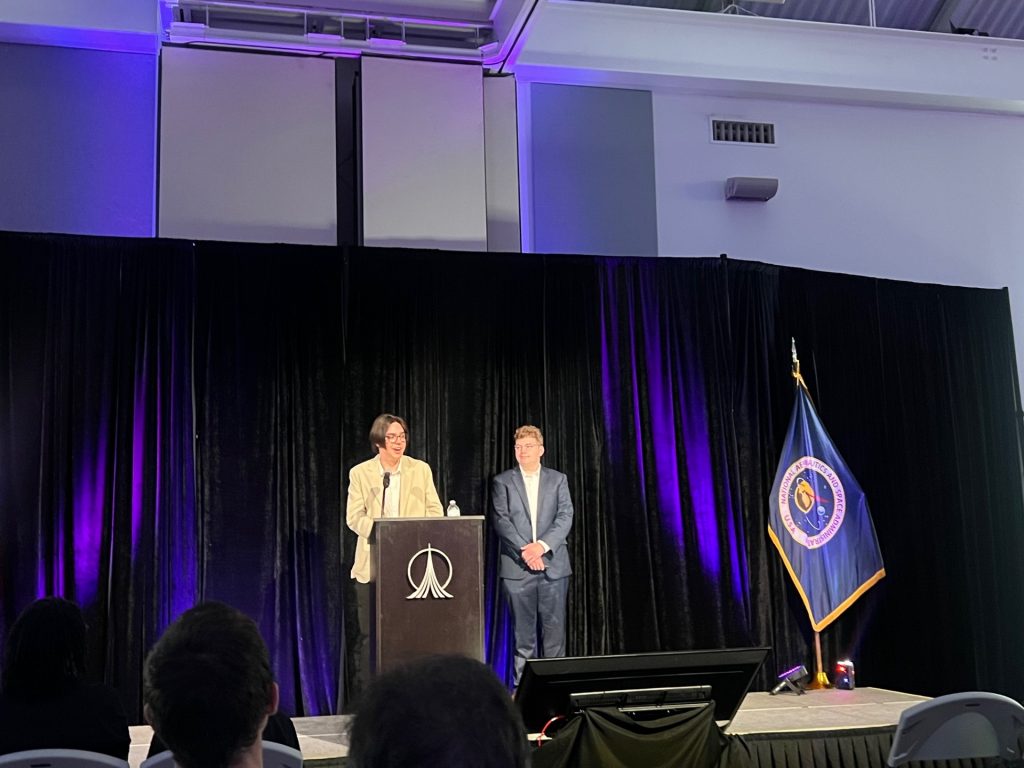
Two UCCS students had the opportunity of a lifetime on July 2, 2025 as they opened the national Student Spaceflight Experiments Program (SSEP) conference with a presentation at NASA’s Kennedy Space Center. Blake MacDonald and Luke Davis, co-principal investigators of the experiment Calcium Sulfate Crystal Growth in Microgravity, confidently set the tone for the day as the first student speakers at the symposium.
Their project, developed alongside teammate and Mechanical Engineering graduate Noah Grebe and under the mentorship of UCCS faculty, was selected as a finalist. Their experiment was flown to the International Space Station (ISS) in November 2024.
“Luke and Blake did so well! It was great having them go first and set the stage for the event,” said faculty facilitator McKenna Lovejoy, an Engineering Professor at Pikes Peak State College (PPSC). “They had some great questions from the audience and answered them like pros.”
The experiment tested how crystals form in space by mixing sodium sulfate and calcium chloride solutions in microgravity, triggering the formation of calcium sulfate dihydrate. After the flight, the team used X-ray diffraction to compare the space-grown and Earth-grown samples. Their findings confirmed both sets shared the same crystalline structure—an important insight for future space-based manufacturing and construction.
“This kind of work helps lay the groundwork for sustainable living and building in space,” said Lynnane George, a faculty collaborator on the project along with Jena McCollum. “Understanding how materials behave in microgravity is critical as we prepare for missions to the Moon, Mars, and beyond.”
The event also featured talks from space science luminaries including Jeff Goldstein, former NASA astronaut Don Thomas, and Patrick O’Neill from the International Space Station National Lab.
“It was an incredible experience to present at Kennedy Space Center,” said Davis. “It made all our hard work feel even more meaningful.”
The research was part of UCCS’s continued involvement with the SSEP, which offers students real-world access to STEM research with direct connections to NASA’s ongoing missions. Under the guidance of Dr. George and Dr. Lovejoy, UCCS and PPSC teams have the opportunity to launch multiple experiments to the ISS.
For MacDonald, Davis, and Grebe, this project wasn’t just about science, it was about reaching new heights. “This has been an amazing opportunity, and I can’t wait to see what the next UCCS/PPSC space flight team(s) will accomplish,” said MacDonald.
For more information about UCCS and PPSC’s ISS launch opportunities, contact Lynnane George at [email protected] or McKenna Lovejoy at [email protected].