
Despite the way life and societies have changed over millennia, most environmental crises and human responses to them have been consistent.
In an effort to assess the success of these responses, UCCS Anthropology Chair and Associate Professor Colin Wren, Ph.D., along with Aarhus University faculty Iza Romanowska, Ph.D., and Felix Riede, Ph.D., examine the four most common methods and their effectiveness in their research “Bad year econometrics: Agent-based modeling of risk management strategies under varying regimes of environmental change.”
Using computer simulations and what they call the “GoodBYE method,” (BYE derived from Bad Year Econometrics) the authors analyzed four strategies: investment in infrastructure, exchange, mobility and economic adjustment; and the resilience, or “a given system’s ability to withstand and recover from external and internal shocks and downturns,” of each. As seen in the table below, each method varies by its predictability and variability.
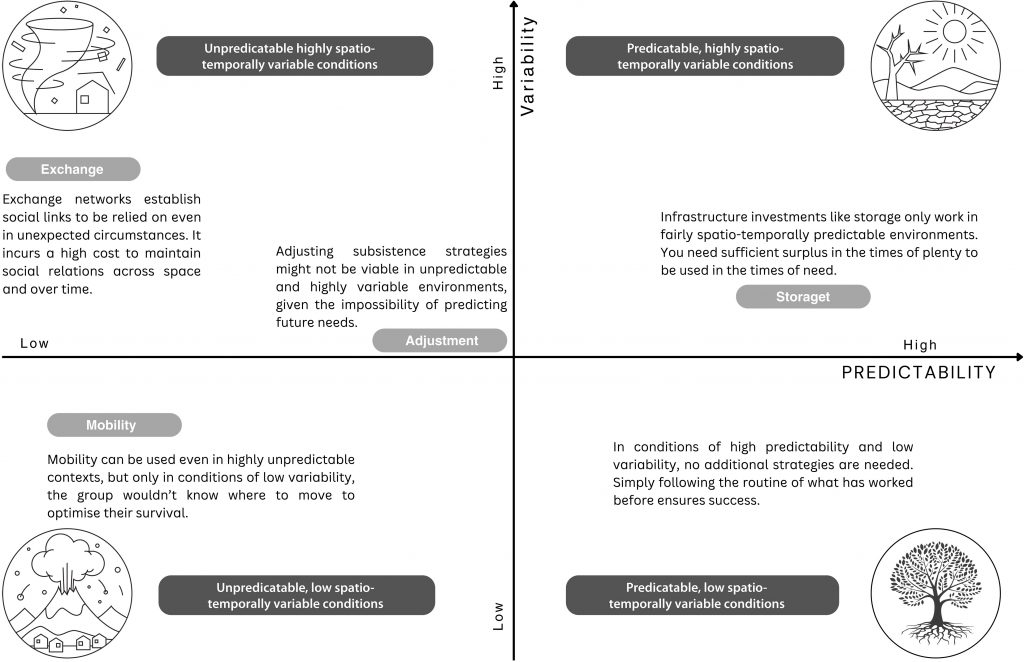
Investment in infrastructure, such as storage facilities or irrigation systems, is effective but requires planning in advance and is not guaranteed to be put to use. Its high costs, inability to be mobile and potential for loss, through decay or decline, make it less flexible. It is, however, a good method for cyclical periods when resources or lack thereof can be more accurately predicted.
Exchange, noted by experts to be a “hallmark human adaptability” was found to be highly flexible and an effective strategy during unexpected periods of temporary resource scarcity. The risk to exchange is its reliance on social networks and high cost, as costs are incurred not only during a crisis but in noncritical periods as well to maintain social relations.
Mobility, a longstanding effective approach throughout history, is considered one of the most straightforward ways to respond and works for even highly unpredictable crises, but relies on established information for where to move to. It was found to be the most effective strategy overall, but loses efficacy in cases of persistent resource loss when there are no areas to move to.
Economic adjustment was the least effective of the four methods, though can be achieved in several ways depending on the lacking resources and is often the most inexpensive. For example, finding new ways to obtain a resource or finding a substitute resource, though this may deplete an already-reduced asset.
Though no strategy is perfect, especially if applied on its own, mapping these methods based on history allows for more predictability in the future. As noted in the study, “While the GoodBYE model is abstract in nature and not intended to be directly validated against a specific set of data, it produces testable predictions, which we illustrate through a series of archeological case studies and a comparative ethnographic analysis.”
“We want people to think beyond the ‘right’ way to react to an environmental crisis,” explained Wren. “We show that no one resilience strategy works in all situations. Mobility was a key strategy in the past, people either moving more frequently or migrating to a new area. However, this is a lot more difficult to do in the modern day. By using a modeling approach like we’ve done here, we can experiment with the possible costs and benefits of other resilience strategies to help plan for future climate impacts.”
Read the entirety of “Bad year econometrics: Agent-based modeling of risk management strategies under varying regimes of environmental change” online, featured in the “Science Advances” journal.