



Inside a hangar at the National Museum of WWII Aviation in Colorado Springs, the past and future of aviation meet, guided by UCCS students learning to engineer both. The nonprofit institution, dedicated to preserving the legacy of World War II aviation, is home to 28 fully restored, flying aircraft and more than 4,000 artifacts and historical documents.
This setting offers a rare opportunity for students to work directly with the history they are helping interpret.
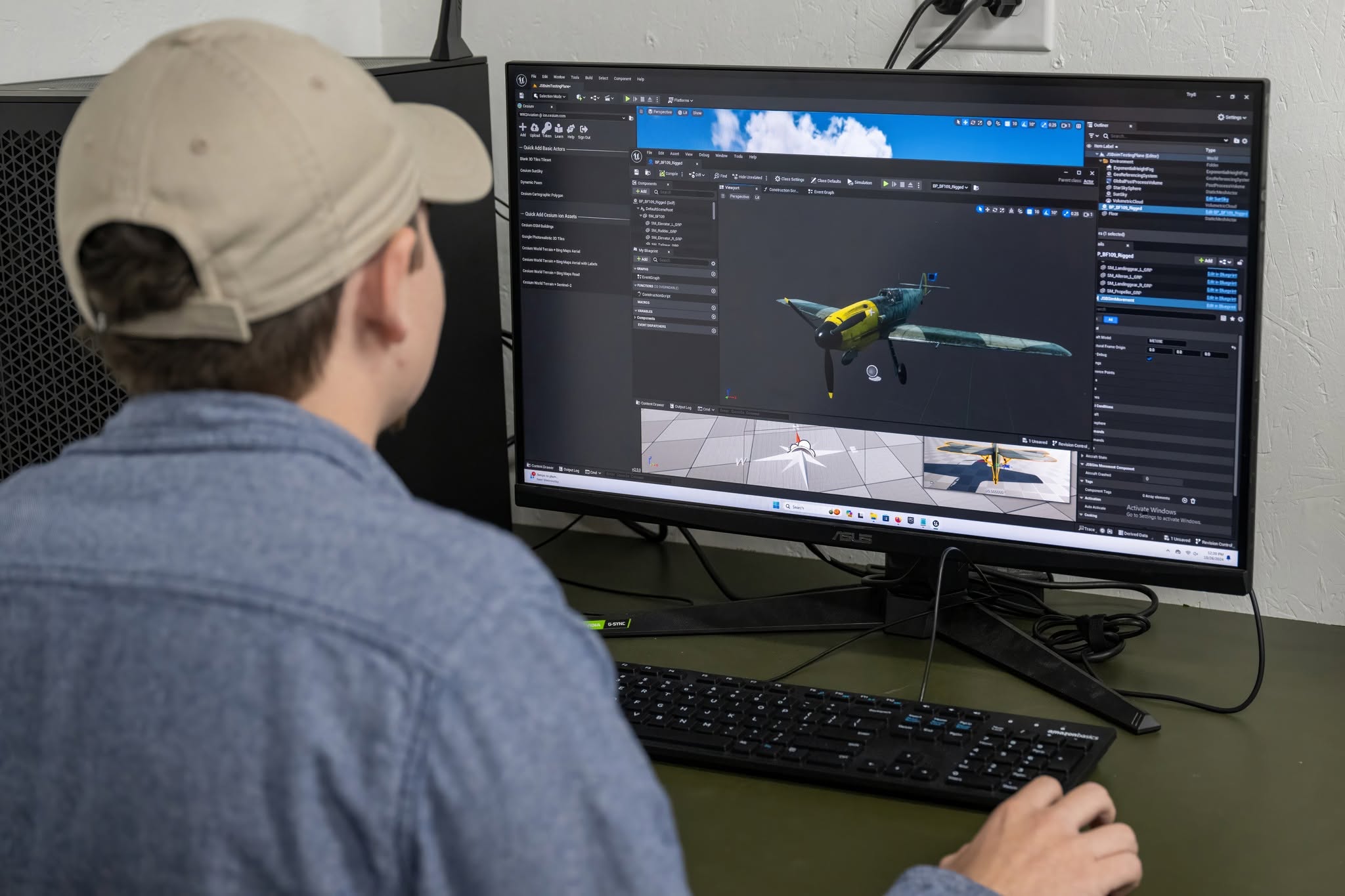
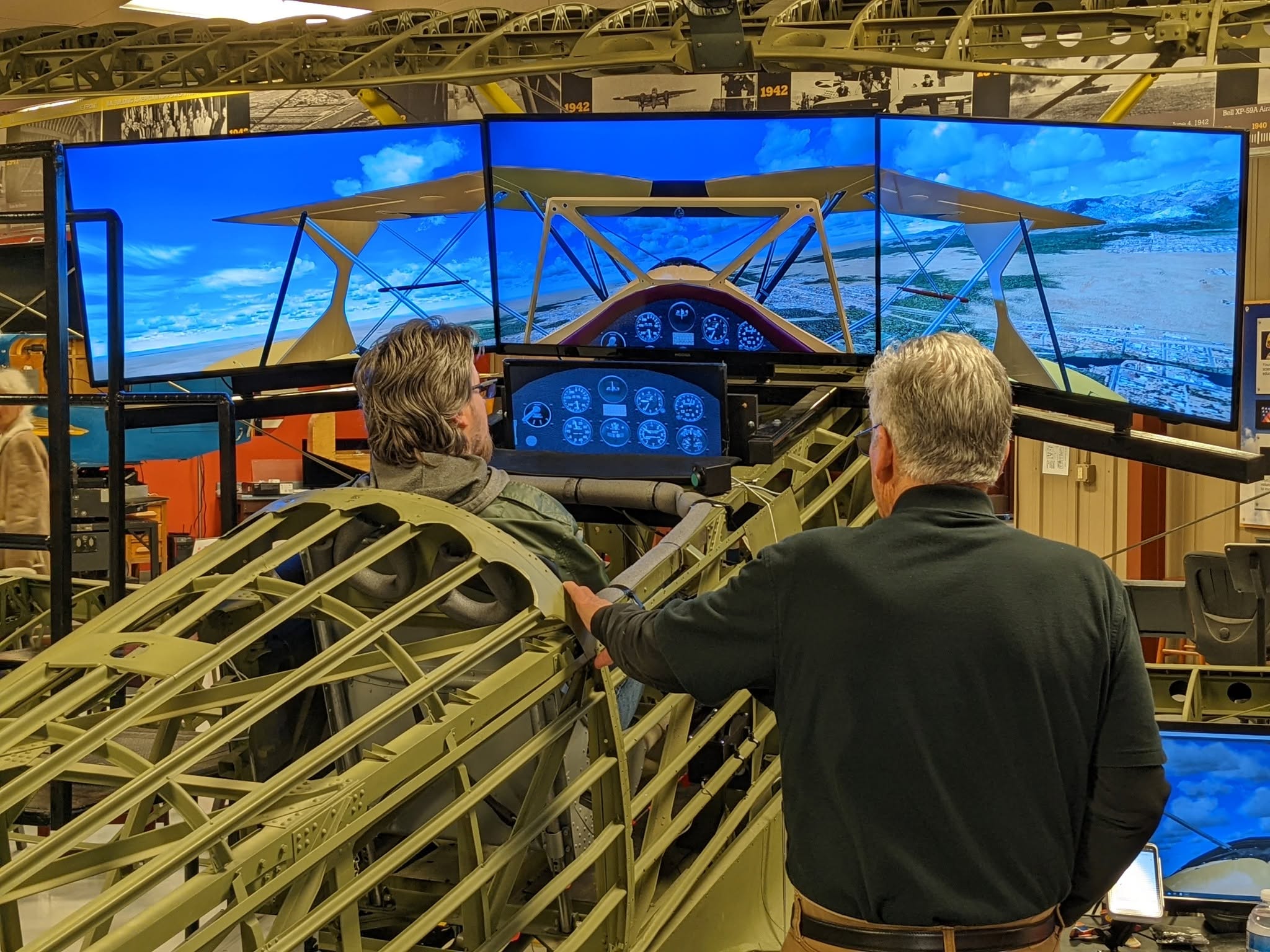
At the center of that work is Nathaniel Griner, a UCCS junior, Army veteran and former helicopter pilot. Nathaniel leads one of the museum’s most ambitious internship projects: a fully interactive B-25 flight simulation.
“There’s a lot that we get to do here that doesn’t happen in the college setting,” Nathaniel said. “As far as game design and development go, there’s a lot more long-term planning. You have to think about how you architect your program…so that you can scale it later on.”
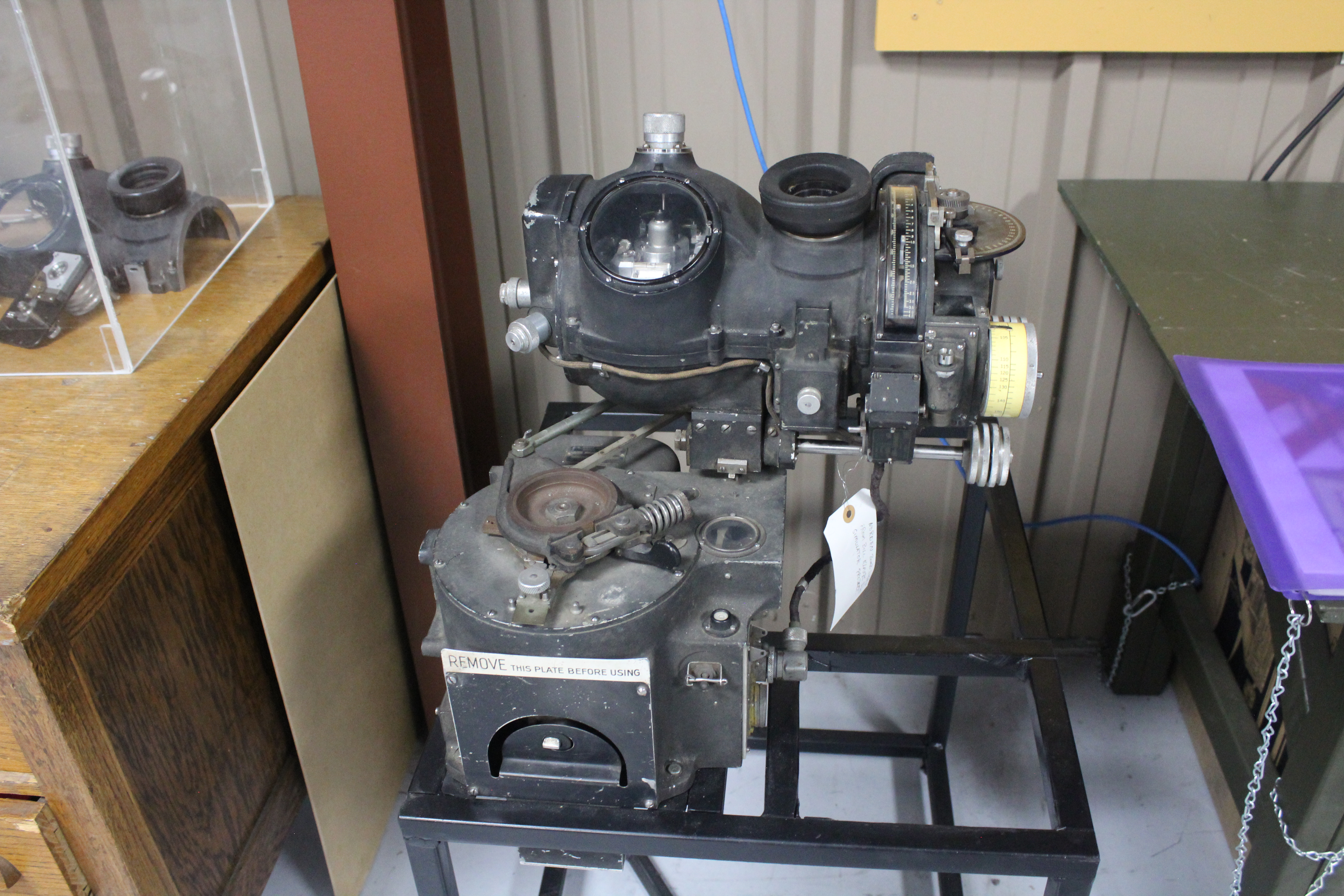
Anthony Spano, also a UCCS junior, works alongside Nathaniel on two additional projects. Anthony leads the development of the B-17 Waist Gunner Simulator and the Norden Bombsight Simulator.
“The Norden bombsight was a major technological advantage the U.S. had over the rest of the world during World War II,” Anthony said. “Essentially, it is an analog computer that will calculate the angle to drop a bomb from 20,000 feet with pinpoint accuracy. The project itself is much different than a normal class assignment; the scale is much larger.”
Unlike traditional coursework or short-term projects, the internship places students in a collaborative, ongoing engineering environment. Teams from multiple disciplines—mechanical, electrical, aeronautical and computer science—work together to design complex simulations using real WWII aircraft components. The program includes anywhere from 12-18 interns in their final two years of college. Graduate students have also taken part, providing an opportunity for other students to learn from their advanced academic experience.
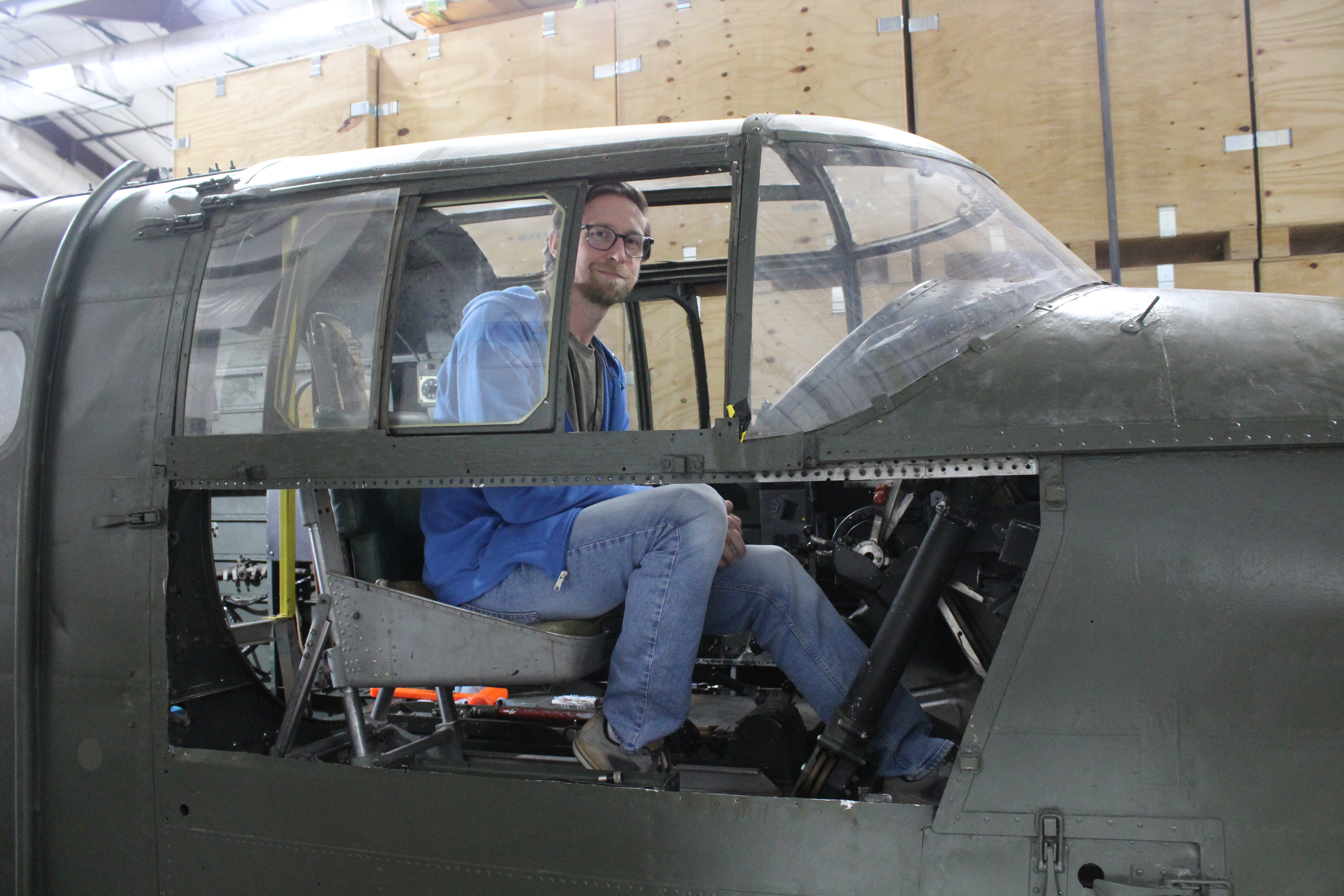
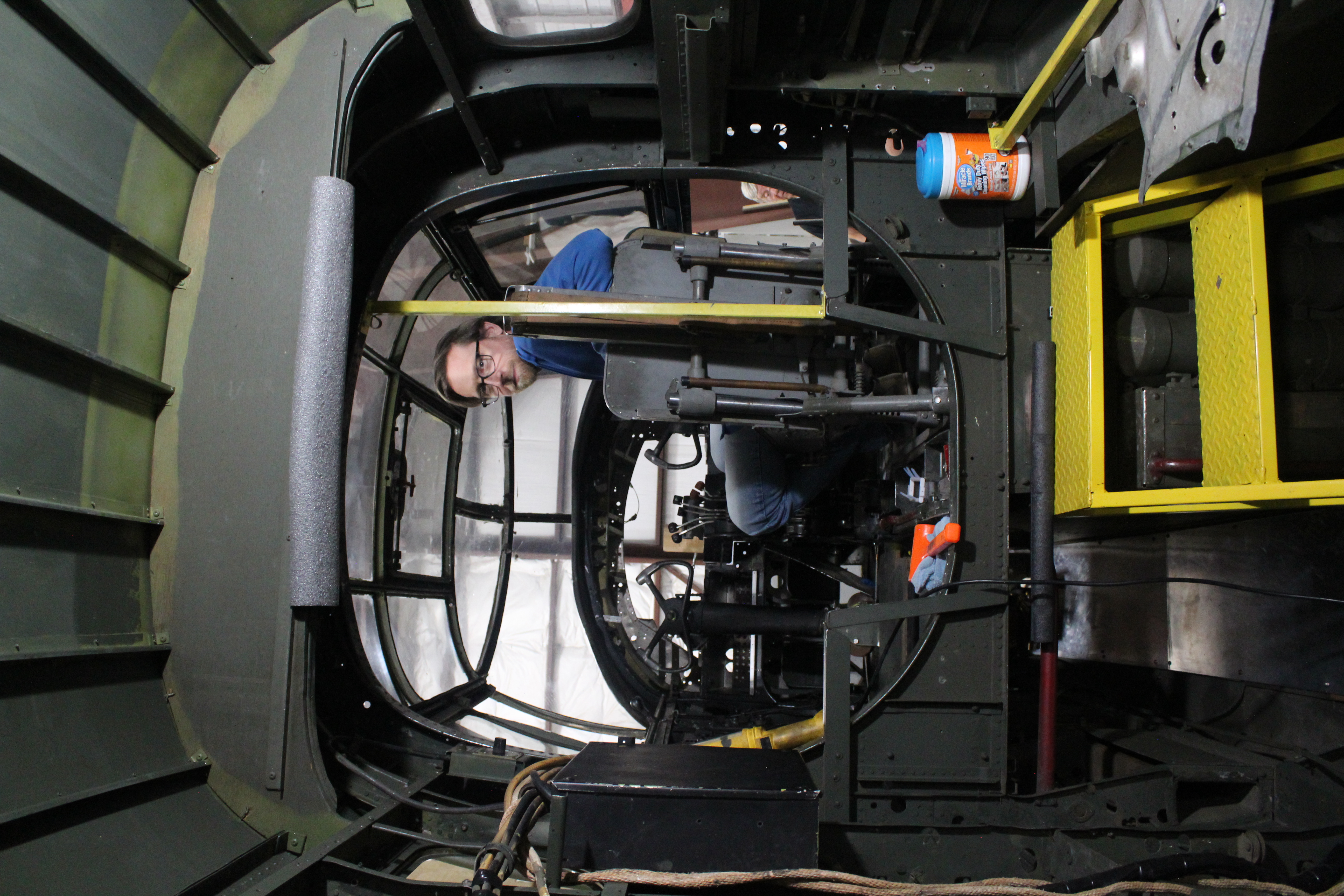
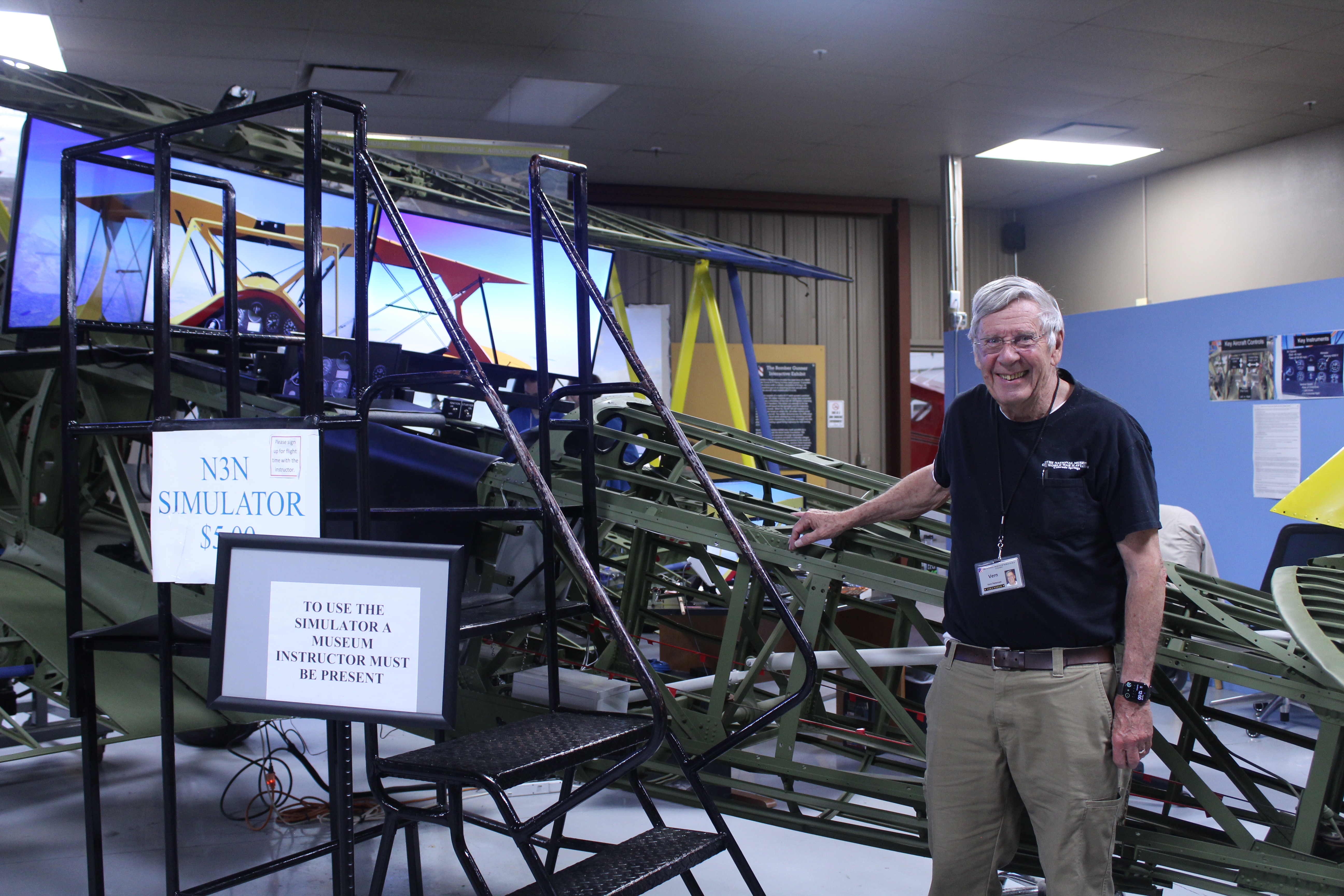
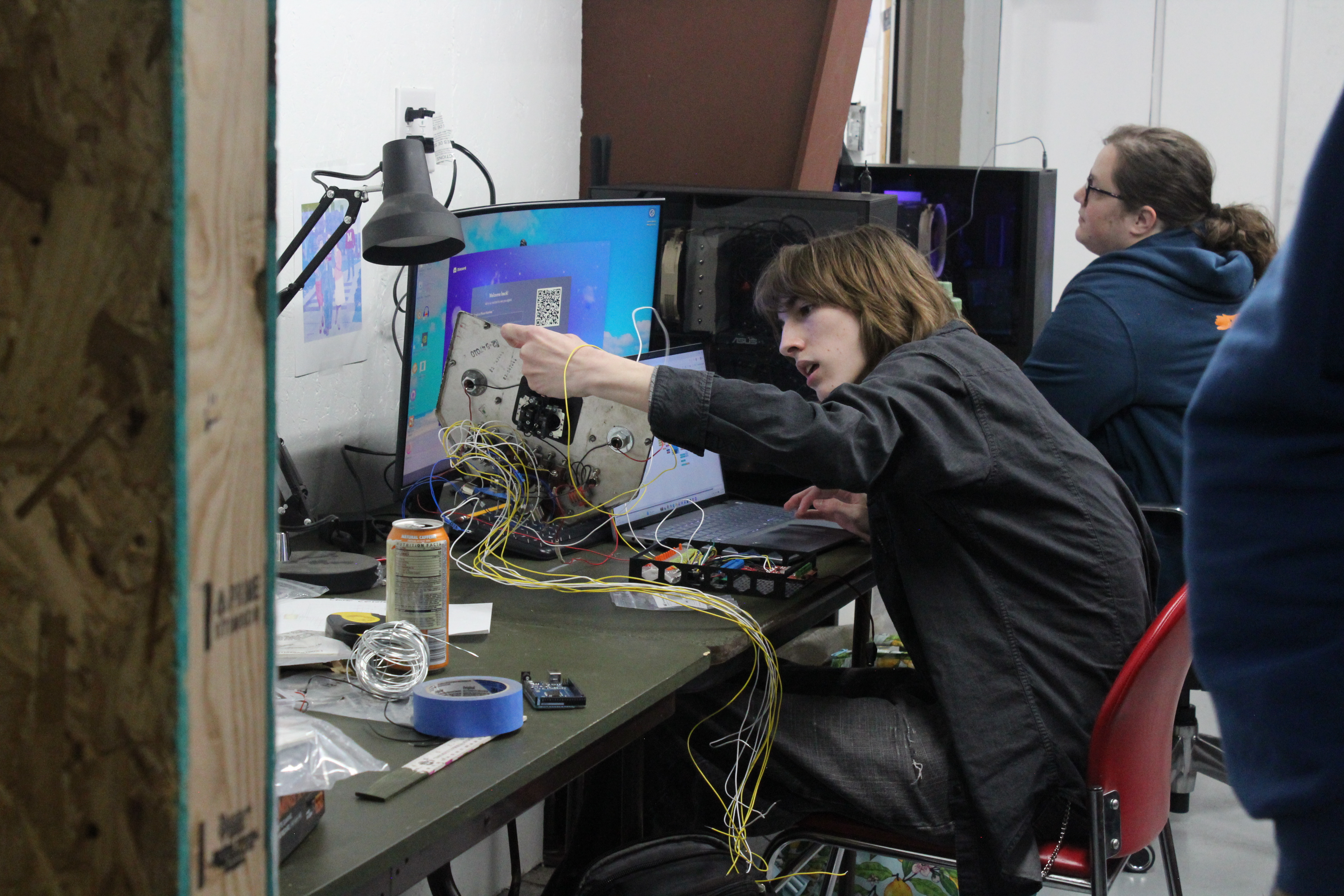
“They’re taking the game design philosophy, adding physics for realism, and putting it in a real piece of hardware,” said Vern Patterson, a retired Air Force colonel who oversees the museum’s Interactive Exhibits Section and the internship itself. “They’re tearing apart the B-25 and putting sensors on all the controls to simulate what it would have been like actually sitting in a cockpit.”
The result is immersive educational technology that will allow museum visitors to experience World War II aviation with striking realism. Students recreate everything from cockpit instrumentation to environmental conditions, translating decades-old mechanical systems into modern digital simulations.
The team also hopes to eventually integrate multiple crew roles into the simulator experience.
“While they’re flying around, the gunner could see enemy planes…and use the bombsight,” Vern said, envisioning a fully interactive environment where visitors work together just as World War II crews once did.
For Nathaniel, that complexity is exactly what makes the experience valuable.
“We’ll have experience working as a team on a real project and creating something that’s new and hasn’t been done before,” he said.
A Veteran’s Perspective
Nathaniel’s military background brings a unique perspective to the work. As a former helicopter pilot, he understands both the technical and human sides of aviation. That knowledge helps bridge theory and application for the student team.
“I was never a fixed-wing pilot, but a lot of it is similar,” he said. “Between what I know and what the aerospace students bring, we can pretty much piece it together.”
That collaborative environment, and the open dialogue it fosters, is intentional. Students are expected to learn from one another, adapting continuously as challenges arise.
“We all have a growth mindset,” Nathaniel said. “I know what I know and I know what I don’t know. From there, we’re going to research or find someone who can help.”
That hands-on learning often extends beyond the simulator and into the museum itself. Nathaniel described working with a fellow student who was adept at game design but was struggling to understand the many systems within the aircraft.
“He didn’t know much about planes,” Nathaniel said, “so we pulled up the maintenance manual and looked at the diagrams.”
Then he remembered something:
“We’ve got the actual planes here,” Nathaniel said.
Standing beside the fully restored, functional aircraft, he pointed out the rudder, trim controls and other components in real time, helping translate theory into something tangible, turning a complex system into a shared learning moment rooted in experience.
Preparing Students for Industry
Bill Klaers, president and CEO of the National Museum of WWII Aviation, said the internship was designed with two outcomes in mind: to build interactive exhibits for the museum and to help prepare UCCS students for the business world through practical application of their skills.
“Putting students in an environment that makes them design something and then build it gives them a better path to success,” Bill said. “We are starting to see local business interest from the employment side. This project is a win-win scenario for all involved.”
The internship also emphasizes working as part of a team, rather than striving to be the smartest person in the room. Vern, the volunteer who oversees the projects, said he noticed a gap in those skills throughout his more than 60 years of experience in government and the industry.
“We’re trying to force them to think a little bit wider and learn how to communicate with people from different backgrounds,” he explained.
Students navigate open-ended problems, build systems that integrate across disciplines, and learn to communicate complex ideas with teammates from different technical backgrounds. They test, fail and iterate, developing the kind of resilience and critical thinking skills the industry demands.
As Vern puts it, “You find out a lot of interesting problems when you try to make things real.”
“We’re pushing state-of-the-art in some cases…like we’re going to do a B-25 run on Tokyo like Jimmy Doolittle did in 1942,” he said. “How do I develop a simulation that handles graphically Tokyo in 1942? We’re developing all that scenery ourselves. And how do I fly over at 150 feet where the resolution is going to be tight, and then expand that out to Tokyo?”
In the museum’s twelve-year history supporting UCCS in the senior design program and now the internship, Vern has shepherded close to 200 UCCS students toward experience with industry-standard tools, documentation practices and version control systems, developing habits that make them immediately valuable to employers.
Students commit significant time—Nathaniel balances full course loads with weekend work at the museum—but the payoff is measurable. Many participants go on to secure internships and jobs in aerospace, defense and technology fields.
“We’re running a very good percentage of students getting jobs,” Vern said.
Nathaniel said he sees a clear connection between the internship and regional career opportunities.
“There are a lot of defense contractors in Colorado Springs,” he said. “Some of the guys here want to work in game development, but if they have a hard time finding a job initially, they can always branch out to the Department of Defense because they’ll have experience making a simulation for an airframe in a game engine.”
Why the Kane Family Foundation Invested
The Kane Family Foundation recognized that impact early on, so much so that the foundation decided to fund the paid internships.
“We just happened to find out about the program,” said Bill Corrigan, president of the foundation. “They provided us with a proposal and we liked it. We bought into it and we’ve worked to expand the program since.”
While the foundation primarily funds scholarships, this internship aligns closely with its values.
“Our program seems to fit with this,” Bill said. “These people have already proven themselves. They’re willing to work.”
That emphasis on work ethic traces back to the foundation’s roots.
“I’m not looking for somebody who wants a job…I want somebody who wants to work,” he added, recalling the words of the foundation’s namesake, Andy Kane.
It’s a philosophy reflected in the internship’s culture, where students are expected to take initiative, solve problems and contribute meaningfully to long-term projects. The foundation’s namesakes, Wanden and Andy Kane, were ranchers and philanthropists from Fountain, Colorado, who believed in independence through education. Together for more than 50 years, the couple, who came from vastly different backgrounds, shared a love of the Western lifestyle and an appreciation for learning.
The foundation also saw the program as a way to strengthen a community asset.
“We all liked the museum tremendously,” Bill said. “We think it’s a great addition to the community,” he added, underscoring their desire to support not just students, but a space that connects history, education and public engagement.
This is all in addition to the integral financial support the Kane Family Foundation has offered toward education for students at seven colleges and universities in southern Colorado, including UCCS.
Bringing History to Life
Beyond workforce preparation, the program also fulfills a broader mission: preserving history through innovation.
“Our purpose is to create interactive exhibits that bring the World War II experience to our visitors,” Vern said. “We use real physics. We want to show people how difficult things were…not just make it a game.”
From flight simulations to training systems, students are helping transform static exhibits into immersive learning environments, ensuring history is not only preserved, but experienced.
Vern has seen firsthand how powerful that can be, particularly for WWII veterans and their families.
“When you get somebody whose father or grandfather was a bombardier or a waist gunner… and they get in and they see some of this stuff, it hits home,” he said. “It brings a whole new life to them.”
Anthony, the lead intern on the Norden Bombsight Simulator, said this opportunity has impacted his life as well.
“I wake up in the morning with a strong feeling of purpose,” he said. “When you know that you are being properly challenged and that your work has an impact, you become more driven in all other aspects of your own life.”
For Nathaniel, the UCCS student and Army veteran working on the B-25 flight simulation, the work is as rewarding as it is challenging.
“Money is nice, but it doesn’t matter if you’re not doing something that you enjoy,” he said. “Something you can look back on and say, ‘I’m glad I did that. That was really cool.’”
In a hangar filled with restored aircraft and cutting-edge simulations, that sentiment feels especially fitting: building something meaningful, while learning to fly toward what comes next.