
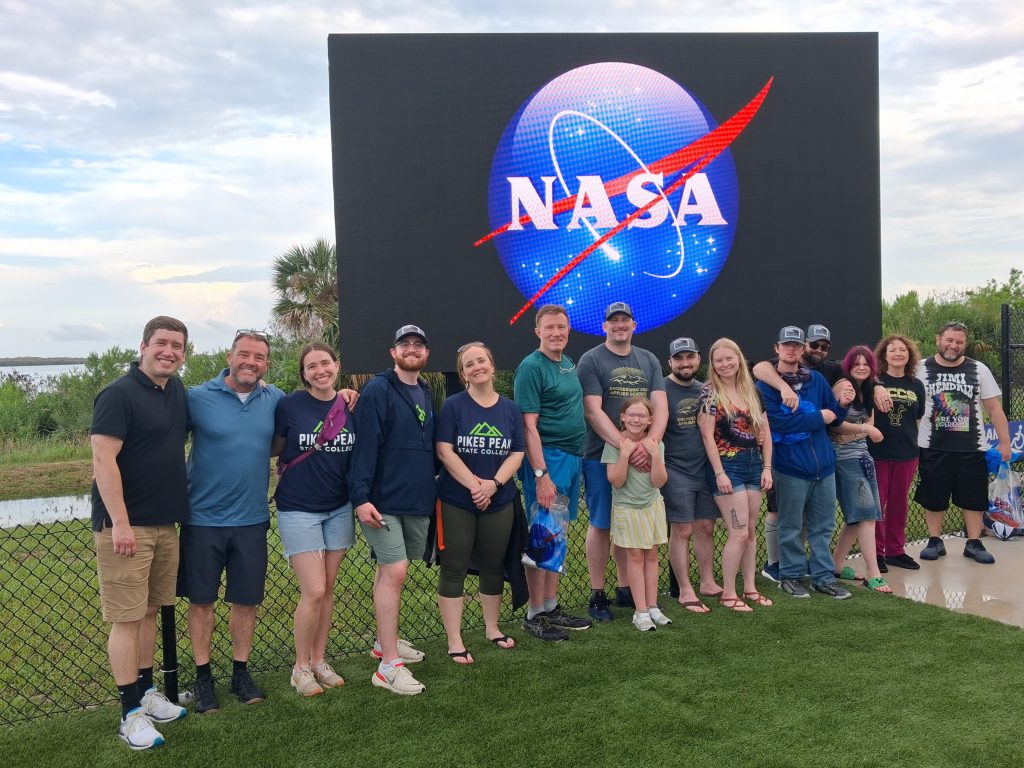
With a project over a year in the making, UCCS students and one Pikes Peak State College (PPSC) student were able to see their efforts realized when their microgravity experiment on fungi and its ability to dissolve metals was successfully launched from the Kennedy Space Center to the International Space Station (ISS).
UCCS seniors Joseph Bate (Physics major and primary investigator for this project), Tristan Dwyer (Biology major), Evan Martin (Aerospace Engineering major), junior William Shimel (Chemistry major), and PPSC sophomore Cody Leeper (Aerospace Engineering major) worked together on their project “Fungal Bioleaching in Microgravity: Fungal Approaches to Metal Recovery,” which was one of only twenty-one proposals chosen for the ISS opportunity, out of over 1,000 submitted.
While the original launch date was set for May 13, weather complications pushed the launch back a few days. This meant that a few of the team’s students were unable to see the launch in person as expected, but they still accomplished an amazing feat that took hard work and effort to prepare and test.
The research itself explores the ability of filamentous fungi in “bioleaching,” the process of extracting metals from electronic waste. The team is testing how the fungi performs in space compared to on Earth by studying metal concentration, acid production, fungal growth patterns, and metal adsorption onto fungal biomass once the specimen is returned to Earth. More specifically, the students will examine how microgravity influences the ability of filamentous fungi to dissolve nickel oxide into nickel ions.
Possible benefits from this research include better recycling of waste that is already present, potential for off-world mining of limited resources and a more sustainable way of resource gathering.