
Every morning—before most of Colorado Springs is awake—bus operators are climbing into their vehicles and beginning to move people: to work, to medical appointments, to school, and to other services. It’s an essential, unglamorous job, and increasingly, it comes with risk.
“At the end of the day, it’s really about getting our operators home safe to their families,” said Chris Kaplan, Senior Program Compliance Analyst at Mountain Metropolitan Transit (MMT), the transit agency operated by the City of Colorado Springs. “These are public servants providing an essential service. They deserve to be protected.”
Kaplan, who completed his Master of Public Administration (MPA) at UCCS in December 2025, has spent the past few years working to build the data infrastructure to do just that. “We want to move beyond a data structure that just satisfies federal reporting requirements, to one that drives organizational learning and systemic safety improvement.”
His capstone research, conducted through the UCCS College of Public Service with Robin Kempf, analyzed MMT’s safety and security incident data spanning six years and over 4,500 incident reports. What he found was both concerning and clarifying: locally, transit worker assaults are increasing dramatically, following a larger national trend. But perhaps equally important was what the data revealed about why assaults happen.
“Most of these incidents aren’t random acts of aggression,” Kaplan explained. “They arise from fare disputes, service complaints, and behavioral health situations. There’s usually a trigger, which means there may be opportunities to intervene and mitigate before a situation escalates.”
That insight has shaped the agency’s response. MMT has since implemented a de-escalation framework, expanded its contracted security program to include roving rapid-response units, and introduced more rigorous after-action review processes to identify patterns and close gaps.
For Kaplan, the work reflects a broader perspective about what good public administration looks like. “It’s a paradigm shift. The data on any problem is likely there, so we have to be creative about how we analyze and use it. Not just for compliance, but to deepen our understanding and drive continuous improvement.”
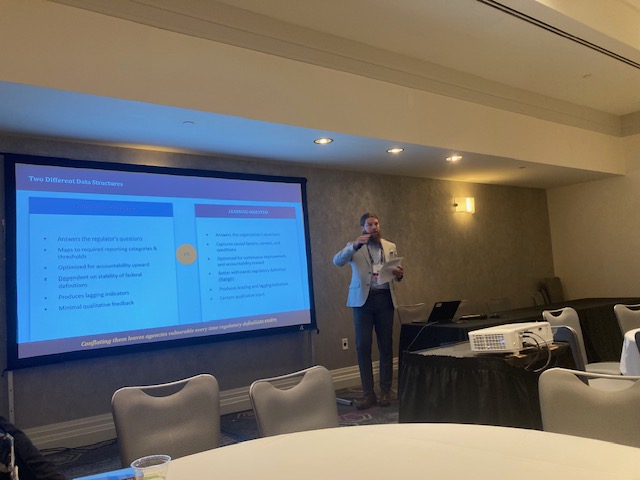
That perspective caught the attention of the American Society for Public Administration (ASPA), which selected Kaplan as a member of its 2026 Founders’ Fellows cohort—a competitive national program recognizing emerging leaders in public service. He presented his research at the ASPA Annual Conference in Hollywood in March, before an audience of academic and practitioner peers.
“I enjoy applied work, translating research into insights that are actionable for public servants on the frontlines. I feel like both UCCS and ASPA truly value this perspective, and the reception at ASPA was genuinely warm. People appreciated the direct connection between the research and operational impact.”
Kaplan credits his UCCS education—and the mentorship of faculty and advisors like Kempf—with giving him the tools to bridge that research-practice gap. And he has no plans to stop there.
“I want to help organizations be the best they can be,” he said. “Wherever I go within public administration, my focus will be on creatively using data and rigorous analysis to drive impact and serve the public as best we can.”
For now, that means continuing to work at the intersection of data, safety, and public service in Colorado Springs, helping make sure that every bus operator makes it home safe each night.