
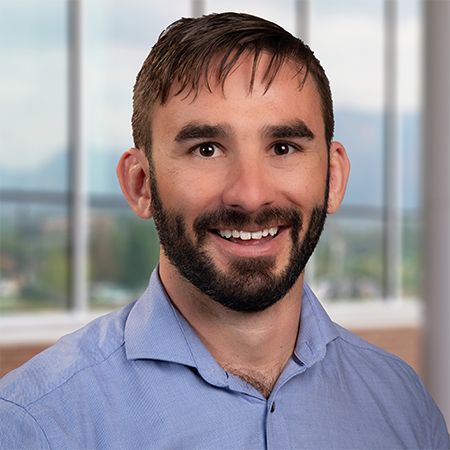
From Canada to Australia to Denmark and ultimately Colorado Springs, Nathan Morris, Ph.D., has spent his career studying how the human body regulates temperature. Now an Assistant Professor of Human Physiology and Nutrition at the Helen and Arthur E. Johnson Beth-El College of Nursing and Health Sciences, Morris leads research that blends physiology and hands-on student involvement.
His interest in thermoregulation began as an undergraduate.
“Since my undergrad honors thesis, it’s always been temperature regulation research,” Morris said. “Originally I thought I wanted to go to med school, and an honors thesis was said to be looked at more favorably because it showed that you had research experience.”
That same type of undergraduate honors thesis experience is now available to students in the UCCS Human Physiology and Nutrition program, giving them the opportunity to conduct research, analyze data and present their projects before graduating.
After taking an environmental physiology course, Morris connected with a professor whose work shaped the trajectory of his academic career.
“I got in contact with a researcher after taking his environmental physiology class and I loved it,” Morris said. “That’s the same professor I ended up doing my honors thesis with, my master’s thesis with, and my Ph.D. thesis with.”
He completed his undergraduate and master’s research in Ottawa before moving to the University of Sydney for his Ph.D.
“I actually helped him move the lab from Ottawa to Sydney,” Morris said. “I got to work with someone I absolutely loved the entire time, while also gaining international experience.”
His early work focused on how the body regulates temperature, including research on temperature-sensitive neurons in the gut. During his Ph.D., his focus shifted toward real-world application.
“My Ph.D. looked primarily at keeping people cool during heat waves if they don’t have access to air conditioning,” Morris said.
Today at UCCS, Morris continues bridging the gap between laboratory research and real-world health challenges. His research explores improving treatment standards for hyperthermia in emergency departments, understanding sex differences in cold tolerance, studying how chemicals influence temperature-sensitive nerve receptors and examining how heat affects behavior.
Inside the lab, Morris and his students measure physiological responses such as heart rate, blood pressure, metabolic rate, skin blood flow and sweating.
“We’ve got the ability to measure local sweating, whole-body sweating, muscle activity, and a lot of other physiological responses,” he said. “Many of the techniques students learn in human physiology classes are similar to what we use in the lab.”
One of Morris’ primary projects focuses on improving treatment for patients who arrive at emergency departments with hyperthermia, a condition where the body’s temperature becomes dangerously elevated. Despite its severity, there is currently no standardized national or international protocol for treatment.
“Often what happens is health authorities make their best guesses based on the information they have,” Morris said. “But sometimes those best guesses turn out to be wrong. That’s why testing these things experimentally is so important.”
His team is comparing several cooling strategies, including ice packs placed at pulse points, ice-soaked sheets with fans and body bags filled with ice.
“One of the most common recommendations is putting ice under the arms, the groin, or the neck,” Morris said. “The theory is that it cools the arteries directly, but physiologically that’s not really what happens.”
Instead, his research shows that cooling a larger surface area of the body is far more effective.
“When we compare these methods to cold-water immersion, the cooling rate is dramatically higher,” he said. “From an effectiveness standpoint, it’s far more powerful.”
Equally important to Morris is the role students play in the lab. Undergraduate researchers are deeply involved and often take on leadership roles.
“All the projects in my lab are student driven,” Morris said. “Usually, we have a student leading the project and one or two students helping run it. Most of the time I’m not even in the lab. It’s the students collecting the data.”
Students can get involved through volunteer work, research practicums for course credit and funded undergraduate research opportunities.
“They’re essentially writing a miniature version of a master’s thesis during their senior year,” Morris said.
For many students, this experience is valuable preparation for graduate programs and medical school.
“Research experience is becoming more and more favored by post-grad health degrees,” Morris said. “Especially for students interested in pre-med, being part of the research process is really valued.”
Morris’ work reflects a broader mission to pair discovery with impact. By combining physiological research with student leadership, his lab is advancing understanding of thermoregulation while preparing students to think critically and apply their learning in meaningful ways.