
The University of Colorado Colorado Springs 2030 Strategic Plan lays out a vision for the future of our university that builds on our core mission: to provide high-quality, accessible education; to advance knowledge; integrate student learning with the spirit of discovery; and to serve our community. These goals form our shared journey—our climb toward the summit of the Success 2030 plan.
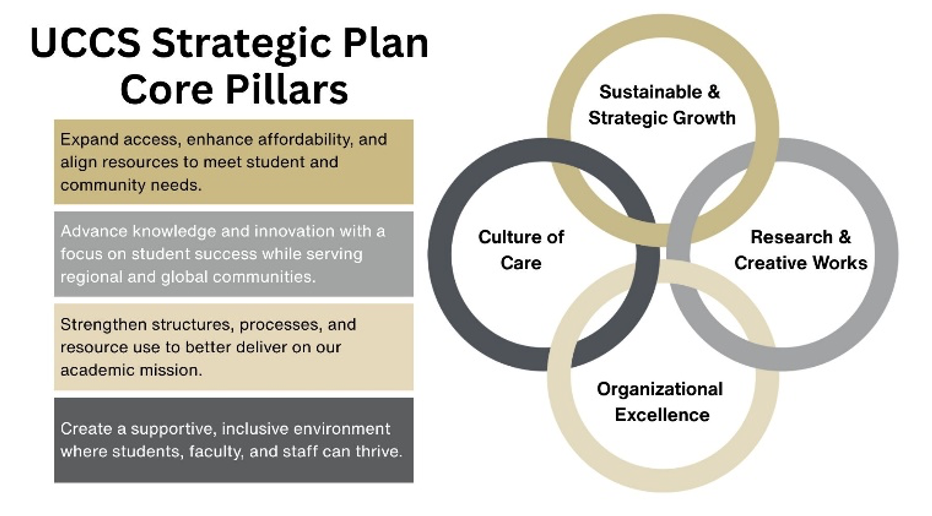
As part of the 2030 Strategic Plan, Four Pillars were identified to help guide this work: Strategic and Sustainable Growth, Research & Creative Excellence, Organizational Excellence and Culture of Care.
Pillar Three: Organizational Excellence highlights a continuous improvement mindset and alignment around organizational excellence. Through these, UCCS is committed to serving students, faculty, staff and the community. By streamlining processes, using accurate data for decision-making and aligning resources responsibly, we operate efficiently and transparently to meet today’s challenges while preparing for tomorrow’s opportunities.
On March 10, The Office of Strategic Initiatives hosted the third Strategic Spotlight Series event highlighting Organizational Excellence. The event featured several areas of campus championing organizational excellence and how they are incorporating it into their work, followed by a Q&A session. Speakers included Joshua Mathias and Aidan Burke on the Student Government Association’s (SGA) Budget Advisory Committee; Human Resources staff members Willow Meyers, Compensation Program Director, and Andrew Archuleta, Director of Talent Acquisition & Compensation, on the Compensation Strategy Project; M.K. Naughton, Digital Accessibility Specialist, and Dave Anderson, Associate Professor Faculty Liaison, on the Faculty Resource Center (FRC) & Digital Accessibility; and Xochil Herrera, Assistant Vice Chancellor of Accounting, on the Financial Stewardship Project.
These initiatives and their support of Organizational Excellence are highlighted below:
- The SGA Budget Advisory Committee supports how the student fee fund is allocated across campus organizations. By examining how fees have previously been utilized, along with projected future costs, they emphasize informed, data-driven decision making to better serve the campus community. The committee’s structured and consistent request and approval process for student club funding prioritizes procedural clarity and efficiency. These strategies uphold resource alignment and transparency–core elements of UCCS’s organizational excellence.
- The Compensation Strategy Project is designed to achieve several key objectives: attract and retain a diverse and talented workforce; motivate and engage employees in achieving the university’s strategic goals; ensure internal and external equity; foster a culture of fairness and collaboration; and sustain fiscal responsibility while rewarding performance and contributions. Through structured data systems, market benchmarking and integrated tools and comprehensive data, compensation frameworks are simplified and structured to align with strategic outcomes while remaining sustainable.
- FRC Digital Accessibility follows the principles of Universal Design of Instruction for the benefit of all students: Flexibility and Access, Proactive Planning, Inclusive Environment, and the Core Principles of equitable use, flexibility, simplicity and safety. Constantly using data-driven information to stay up-to-date on digital accessibility technology and utilizing a Digital Accessibility Specialist to ensure that best practices and tools are used keeps access across campus simplified and flexible, while minimizing remedial accessibility fixes and long-term accessibility barriers.
- The Financial Stewardship Initiative focuses on the new financial procedure: Spending Reserve and One-Time Temporary Funds, which provides a clear and consistent framework for how UCCS plans, allocates and manages temporary financial resources. This initiative keeps the management and tracking of funds consistent and transparent; prioritizing accurate entries, deficit prevention and long-term planning to use informed oversight and reliable data to align with UCCS’s goals of responsible allocation and financial sustainability.
Watch the event recording here.
There are many more initiatives featuring UCCS’ Organizational Excellence. A few of those include:
- The Graduate Director Compensation and Workload Initiative advances Organizational Excellence by clarifying expectations, standardizing workload, and aligning compensation for Graduate Directors, which strengthens role sustainability and accountability across programs. By supporting consistent leadership capacity and reducing administrative strain, the initiative enables more efficient operations and higher-quality academic oversight, directly contributing to a well-functioning and effective organization.
- The College of Business has recently launched the Project Management Minor. Although still in the development phase, this new program will equip students students with standardized project planning, execution, and leadership skills that improve efficiency, accountability, and cross-functional collaboration. The program aims to embed best practices in project management across disciplines, strengthening institutional capacity to deliver complex initiatives effectively and consistently.
- In Spring 2026, the College of Education is kicking off the Universal Design “Boost” for UCCS classrooms. This initiative improves instructional consistency, accessibility, and usability across learning environments, supporting efficient course delivery and reducing the need for reactive accommodations. By proactively designing classrooms that work for a wide range of learners and instructors, the initiative strengthens institutional effectiveness and promotes sustainable, high-quality teaching practices.
- The Textbook Affordability and Access Program (TAAP) program ensures all students receive timely, equitable access to required course materials, removing or reducing financial and logistical barriers to academic success. It operates through a streamlined, integrated, automated system that simplifies material delivery, enhances the learning experience, and supports institutional efficiency.
Organizational Excellence encompasses the intentional and continuous improvement mindset that is occurring with every college and division at UCCS. The work of our faculty, staff and students in pursuit of organizational initiatives is being highlighted on the Strategic Pillars Action Website. We look forward to seeing you all at the next Spotlight Series event on April 20 to learn more about Culture of Care.
Read the first Strategic Pillar Series Article on Pillar 1: Strategic & Sustainable Growth and the second on Pillar 2: Research & Creative Excellence.