
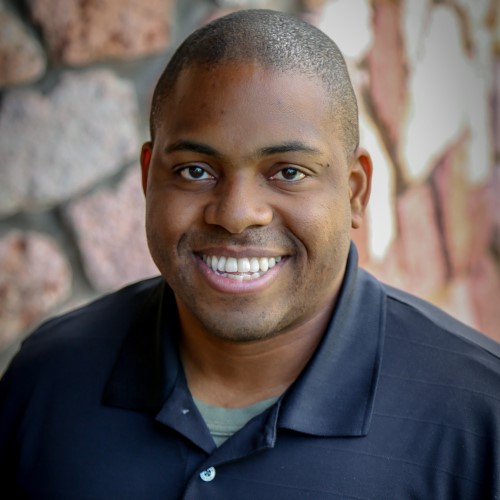
Get to know Keston Lindsay, Ph.D., CSCS, Associate Professor in the Human Physiology & Nutrition Department and Assistant Dean for Academic Affairs and Operations in the Helen and Arthur E. Johnson Beth-El College of Nursing and Health Sciences.
Lindsay shares the story behind his passion for research and education with Maren Burkhart, Marketing Specialist & RN-BSN Student Advisor. Learn more in the below conversation with Lindsay (KL) and Burkhart (MB).
MB: What is your educational background?
KL: My undergraduate degree is in biology. I have my Ph.D. in exercise science, and I also have three master’s degrees in health sciences, psychology and mathematics.
MB: Why three master’s?
KL: I just like to learn. My first master’s was in health sciences, which had an exercise science background. At the time, I wanted to be a strength and conditioning coach. When I was learning sports science and exercise science, the field was still new, and it was difficult to find strong mentorship. While working as a strength and conditioning coach at my school, I developed an interest in sports psychology and how mental health affects student-athlete outcomes. That led me to pursue my master’s degree in psychology.
After that, I told myself I was done with school and would continue working as a coach. Eventually, I transitioned into athletics administration as an assistant facilities director. Around the same time, I began teaching and discovered a passion for it. That experience made me realize I wanted to become a professor, which led me to pursue my Ph.D. in exercise science.
When I started my doctoral program, I found that kinesiology is highly multidisciplinary. In my department, we had adapted physical education, exercise physiology, biomechanics and sport management. The program required all doctoral students to take a certain number of credits outside the department to gain broader experience.
That is how I found myself taking classes in the math department. During my first semester, I took a statistics course. It was intimidating at first, but my professor was excellent. I took another statistics course with the same professor the following spring and really enjoyed it. That experience sparked a deeper interest in statistics and quantitative research methods.
MB: You were awarded the Outstanding Teaching Award twice. What contributes to your success in the classroom?
KL: Statistics is a difficult class to teach because students often do not understand why they need to learn it, at least not right away. Research shows that students tend to focus only on subjects directly related to their field, whether that is anatomy, physiology, exercise science or nutrition.
It is usually not until they take their senior seminar or a program evaluation course, or when they begin working in a lab, that they realize how important statistics is.
I approach my classes with that in mind. I work to make learning engaging and approachable. I use humor, encourage group assignments and emphasize collaboration rather than long lectures. I want every student to feel included and to have an equal opportunity to succeed.
MB: Can you talk about your area of research?
KL: I enjoy introducing exercise scientists to new statistical methodologies. My research focuses on quantitative methodology in the health sciences and physiology. That focus includes several areas, but one of the main aspects of my work is creating instruments.
MB: Can you give me a definition of an instrument?
KL: An instrument is essentially a questionnaire or scale. The questions must be carefully developed and validated, and the instrument itself must be tested with a large enough group, usually several hundred participants, to ensure accuracy and reliability.
MB: One of your projects compares health outcomes among weightlifters. What inspired that?
KL: I am a weightlifter myself, and I noticed that there were no validated instruments available to measure and compare health outcomes among weightlifters. I decided to create one.
The project is ongoing because I am working to gather a strong and high-quality sample. My goal is to collect data from about 2,000 participants. I have reached around 1,000 so far, but not everyone who receives the survey fills it out.
We began with qualitative interviews with six people who were either athletes or dedicated weightlifters. This helped ensure the questions made sense before we launched the survey on Qualtrics.
I have collected data at competitions as well, which has been a learning experience. We discovered that collecting data on competition day is not ideal because athletes are focused and do not want to be bothered. The day before, during weigh-ins, works much better because they are calmer and more willing to participate.
We also found that audience members, who are often fellow lifters or fitness enthusiasts, are more open to filling out surveys during competitions. My undergraduate students help collect data at the recreation center, and I often ask potential participants directly when I see them. We plan to continue collecting data gradually until we reach the target number of participants.
MB: What advice do you have to students who are currently in their academic career?
KL: It varies from student to student, but the biggest piece of advice I can give is to get out there and gain hands-on experience in the field you think you want to pursue.
Many students have a glorified idea of what their future career will be like. I encourage them to take advantage of internships or other opportunities to see what the work is really like. Sometimes they confirm it is what they love, and other times they discover it may not be the right fit.
Another important piece of advice is to pace yourself. Some students are so driven that they push themselves to the point of burnout. I have seen excellent students with ambitious goals become overwhelmed when personal challenges arise, and they lose their motivation completely.
It is important to take breaks and give yourself time to rest. If it takes an extra year or two to graduate, that is perfectly fine. Finding a balance between your goals, responsibilities, and mental health is essential.
Just because something is what you want to do now does not mean it is what you will be doing in five or ten years. Enjoy the process, stay flexible, and be open to where life takes you. You will face unexpected crossroads, and often those are the moments that lead to the most rewarding opportunities.
About the UCCS College of Nursing and Health Sciences
The Helen and Arthur E. Johnson Beth-El College of Nursing and Health Sciences provides both traditional and accelerated undergraduate nursing, graduate nursing and health sciences degrees. Established in 1904, the college offers state-of-the-art facilities, including the Johnson Beth-El Clinics at the Lane Center, sports medicine programs through the William J. Hybl Sports Medicine and Performance Center and advanced clinical rotation supplementation through the Simulation Learning Center. Learn more about the Johnson Beth-El College of Nursing and Health Sciences at UCCS.